Spine Surgery at 80 and Beyond: Minimally Invasive vs. Open Technique in Octogenarians With Adult Spinal Deformity
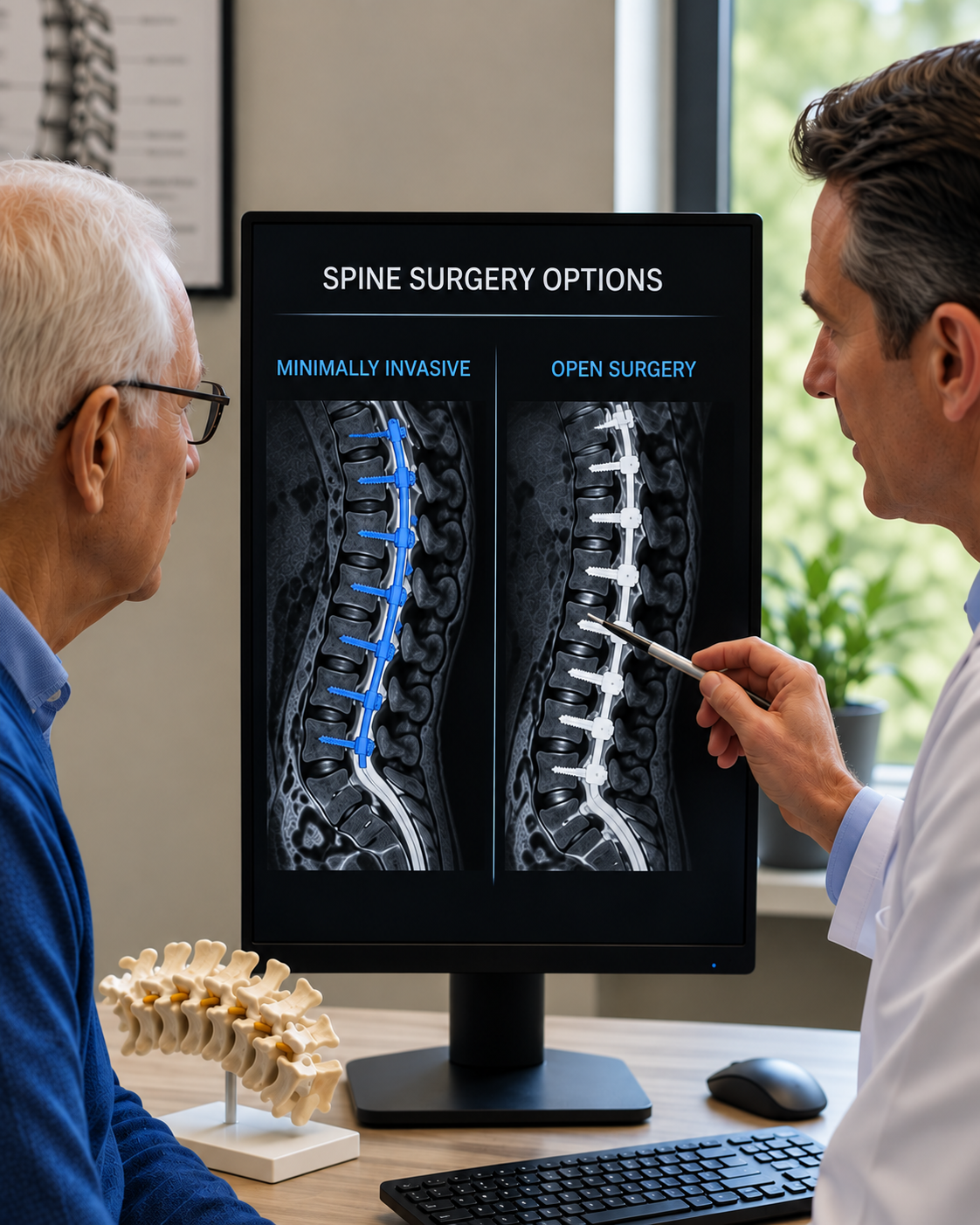
The first propensity-matched study of its kind finds that minimally invasive surgery reduces short-term burden in patients over 80, while open surgery offers greater two-year durability — with meaningful tradeoffs for both approaches.
OPENING SUMMARY
Deciding whether to operate on a patient in their 80s with adult spinal deformity is already a complex and consequential conversation. Deciding which surgical technique to use adds another layer of uncertainty — one that, until now, has been largely unsupported by direct comparative evidence. This study is among the first to examine that question head-on, comparing circumferential minimally invasive surgery (cMIS) against traditional open technique in octogenarian ASD patients using propensity score matching to control for differences in baseline health and deformity severity. What emerges is not a clear winner, but a clinically important tradeoff: one approach reduces the immediate physiological burden of surgery, while the other delivers more durable long-term correction.
STUDY SNAPSHOT
Study type – Propensity-matched retrospective analysis
Number of patients – 34 octogenarian ASD patients meeting inclusion criteria
Age criterion – 80 years or older
cMIS group – 10 patients (29.4%)
Open group – 24 patients (70.6%)
Propensity matching variables – Charlson Comorbidity Index, C7–S1 sagittal vertical axis, pelvic incidence minus lumbar lordosis mismatch, C7 plumb line
Follow-up – 2 years
Outcome domains – ICU admission, hospital stay, patient-reported outcomes (SRS-22), MCID achievement, reoperation rates, mortality
Published in – Operative Neurosurgery
PMID – 42507074
DOI – 10.1227/ons.0000000000002145
WHY THIS MATTERS
The global population is aging, and with it, the number of older adults living with adult spinal deformity severe enough to cause significant pain, disability, and loss of independence. Historically, patients in their 80s have been considered high-risk surgical candidates — and many have been counseled away from surgical correction on the basis of age alone. But age is an imperfect proxy for surgical risk, and increasing evidence suggests that carefully selected older patients can achieve meaningful functional improvement from ASD surgery.
What has been missing from the literature is a direct comparison of surgical techniques specifically in octogenarians. Minimally invasive approaches have been associated with reduced blood loss, shorter hospital stays, and faster recovery in younger ASD populations — making them an intuitively appealing option for older, more fragile patients. But whether those short-term advantages translate into durable long-term outcomes in patients over 80 has not been previously assessed.
This study addresses that gap with the first propensity-matched analysis of cMIS versus open ASD surgery in octogenarians, providing the field with early but important evidence to inform surgical planning conversations with this population.
KEY FINDINGS
1. Minimally invasive surgery significantly reduced short-term physiological burden. The most striking perioperative difference between groups was ICU admission rate: only 10% of cMIS patients required surgical intensive care, compared to 75% of open patients — a highly significant difference (P <.001). Hospital length of stay was also substantially shorter in the cMIS group (4.6 vs. 10.1 days; P = .013). For patients in their 80s, for whom prolonged hospitalization and ICU stays carry their own risks — including delirium, deconditioning, and hospital-acquired complications — these differences are clinically meaningful beyond the statistical signal.
2. Open surgery delivered better patient-reported outcomes at two years. At the two-year follow-up, open surgery patients reported significantly higher scores in the Appearance and Mental health domains of the SRS-22 — a validated patient-reported outcome measure widely used in spinal deformity research. Open patients also more frequently reached the minimum clinically important difference (MCID) in both domains (P = .025 and P = .024 respectively). These findings suggest that while cMIS reduces the burden of the surgical experience itself, open surgery may be delivering more complete and durable correction of the deformity — and that patients can perceive and report that difference.
3. Minimally invasive patients had higher reoperation rates for sagittal imbalance. After controlling for Charlson Comorbidity Index and posterior fusion length, cMIS patients were significantly more likely to require reoperation for radiographic sagittal imbalance by two years (20.0% vs. 8.3%; P <.001). This finding is consistent with observations in younger ASD populations, where achieving full sagittal correction through MIS techniques can be more technically challenging than with open approaches — and suggests that this limitation may be amplified in octogenarians, where the deformity severity and reduced physiological reserve make reoperation particularly consequential.
4. No deaths occurred in either group at two years. Despite the age and complexity of this patient population, there were no deaths in either surgical group by the two-year follow-up. This is a clinically significant safety finding that challenges the assumption that patients over 80 are uniformly too high-risk for major spinal deformity surgery. While the cohort is small and these findings require validation in larger studies, the absence of mortality in both groups provides meaningful early reassurance.
5. Propensity matching allowed a more balanced comparison than raw group comparisons would permit. Because cMIS and open patients differ systematically in baseline characteristics — with open surgery more commonly offered to patients with more severe deformity — direct comparison without adjustment would conflate technique effects with patient selection effects. Propensity score matching on Charlson Comorbidity Index, sagittal vertical axis, pelvic incidence–lumbar lordosis mismatch, and coronal C7 plumb line helped create more comparable groups, strengthening the validity of the between-group comparisons.
PRACTICAL IMPLICATIONS
The surgical approach decision in octogenarians involves a genuine tradeoff — not a clear hierarchy. This study does not establish that one technique is superior to the other for patients over 80. Instead, it characterizes a real clinical tradeoff: cMIS reduces the immediate burden of surgery and hospitalization, while open surgery delivers more complete and durable correction with lower reoperation risk. For individual patients, the relative weight of these tradeoffs will depend on their comorbidity burden, deformity severity, physiological reserve, and personal goals for surgery.
Patients who are least able to tolerate reoperation may be best served by open surgery if they can tolerate the initial procedure. The higher reoperation rate in the cMIS group is particularly consequential in octogenarians, for whom a second major spine surgery carries compounding risk. For patients with significant deformity where achieving durable sagittal correction is critical to functional goals, the data suggest that open surgery — if the patient can tolerate its greater initial physiological demand — may reduce the likelihood of a return to the operating room.
The ICU and length-of-stay advantages of cMIS may be decisive for the most fragile patients. Conversely, for patients whose physiological reserve is insufficient to tolerate a prolonged open surgery and extended hospital course, the cMIS advantages in ICU admission and length of stay may outweigh the risk of a higher reoperation rate. Identifying these patients prospectively — through frailty assessment, cardiopulmonary evaluation, and individualized risk stratification — is essential to aligning technique selection with patient capacity.
Age alone should not be a contraindication to ASD surgery. The absence of mortality in both groups at two years is an important data point for counseling conversations with patients and families who may assume that surgery at 80 or older is inherently too dangerous. While these findings are preliminary and come from a small cohort, they contribute to a growing body of evidence that carefully selected octogenarian patients can undergo major spine surgery with acceptable outcomes.
This study highlights an important gap in current MIS technique for severe deformity correction in older patients. The higher reoperation rate for sagittal imbalance in the cMIS group suggests that current minimally invasive techniques may not yet reliably achieve the degree of sagittal correction needed for long-term durability in octogenarians with significant deformity. This is an active area of technical development in the field, and future advances in MIS instrumentation, planning tools, and intraoperative navigation may narrow this gap.
CONCLUSION
This study offers the first direct, propensity-matched evidence on a question that matters increasingly as the population ages: for patients in their 80s with adult spinal deformity, does the choice between minimally invasive and open surgery make a difference — and if so, how? The answer is yes, and the difference runs in two directions simultaneously. Minimally invasive surgery reduces the immediate burden of the procedure and hospitalization. Open surgery delivers more durable correction and better patient-reported outcomes at two years, with lower reoperation rates. Neither approach is universally superior. Both can be performed safely in this age group, as evidenced by zero mortality in either group at two years. The field's next task is developing better tools to match the right technique to the right octogenarian patient — and this study provides the first empirical foundation for that work.
READ THE FULL STUDY